
Why We Use 13-Week Sprint Plans: The rhythm that helps founders regain control, restore clarity, and scale with confidence
In every business I’ve ever worked with, there comes a moment when success begins to feel heavier than struggle.
Revenue is up. The team has grown. Opportunities keep arriving.
And yet, the founder looks across the boardroom table and says quietly, “It shouldn’t feel this hard.”
That moment usually arrives not because the company has lost direction, but because it has outgrown the way it plans.
Most small and mid-sized companies begin with instinct. The founder’s vision is clear, the market is responsive, and progress happens fast. Strategy lives in a notebook or in the founder’s head, and somehow the pieces fit. But growth multiplies complexity. More people, more clients, more systems, each layer adds friction. The same energy that once drove results now fragments across dozens of competing priorities.
The first sign of strain is subtle. Deadlines slip. Projects run just a little longer than they should. Meetings multiply while decisions slow. The founder spends more time coordinating and less time creating. Then the big question surfaces: “Where did our rhythm go?”
That’s where the 13-week sprint plan comes in.
Why Traditional Planning Breaks When You Start to Scale
Most small and medium-sized businesses operate with an annual plan. It’s logical, predictable, and gives structure to the year. But as companies grow, those 12-month strategies start to collapse under their own weight.
At first, annual planning feels productive. You gather your team, set goals, define initiatives, and create timelines. Everyone feels aligned. Then reality hits.
Markets shift. Clients change direction. Key hires leave. A process that worked at ten people breaks at thirty. Suddenly, that carefully built plan no longer reflects the world you’re operating in.
The plan becomes a reference document, not a guide. You’re managing change instead of momentum. The goals still matter, but the path to reach them becomes unclear.
That’s the problem with annual planning. It assumes the environment won’t change. But in modern business, change isn’t the exception; it’s the rule.
And this is exactly where 13-week sprint plans make the difference.
The Turning Point
Over the years, I’ve seen the same moment play out again and again inside growing businesses. A founder builds momentum, the team expands, and success starts arriving faster than systems can keep up.
One managing director described it perfectly during a strategy session:
“It feels like the business is a machine with all the belts spinning at once, but none in sync.”
That comment stayed with me because it captures what so many founders experience when growth turns from exciting to exhausting.
When we looked closer at their operations, the issue wasn’t strategy; it was structure. Their annual plan was impressive, full of detailed revenue targets, marketing launches, and hiring projections. But underneath, communication loops were long, priorities shifted weekly, and meetings were consuming more time than they were saving.
So instead of overhauling everything, we simplified. We defined one measurable 13-week outcome: reduce project delivery time by 25 percent.

Then we asked three questions:
What are the key drivers that influence that outcome?
Who owns each driver?
What does progress look like every week?
Within days, the noise started to clear. The team understood where to focus, who was responsible, and how success would be measured. Every meeting, every task, every decision connected back to that one target.
By the end of the quarter, they hadn’t just improved delivery times; they’d restored momentum, clarity, and confidence.
It’s a story I’ve seen repeated across industries. When companies switch from annual ambition to quarterly rhythm, growth starts to feel lighter again.
Why 13 Weeks Works
There’s a reason 13-week sprints are the backbone of high-performing companies. They strike the perfect balance between focus and flexibility.
Thirteen weeks is long enough to create meaningful change, but short enough to stay emotionally engaged. People can visualise it, commit to it, and measure it without feeling overwhelmed.
It’s also the natural rhythm of how teams sustain momentum. After about three months, attention starts to fade, priorities shift, and the energy behind a goal begins to drift. Resetting every quarter restores clarity and keeps learning continuous.
A 13-week plan doesn’t replace long-term strategy; it activates it. It breaks big goals into measurable, actionable steps that can be executed, tracked, and refined in real time.
The result is accountability, adaptability, and a business that grows by design, not by reaction.
How to Structure a 13-Week Sprint
Once you’ve taken the time to assess what’s working and what’s not, it’s time to turn that insight into a clear and measurable plan for the next 13 weeks.
This isn’t about doing more. It’s about focusing on what will have the greatest impact.
Here’s how to build your own 13-week sprint plan.
Step 1: Define One Clear 13-Week Goal
Start with one measurable outcome that will move your business forward.
Examples:
Increase profit margin from 32 to 38 percent
Reduce client onboarding time from 10 days to 4
Increase lead-to-sale conversion from 18 to 25 percent
This goal becomes your North Star for the quarter. Every decision and action should connect back to it.
Clarity creates energy. When everyone knows what success looks like, they can make better choices about how to get there.
Step 2: Identify Three Key Drivers
Once the goal is set, identify the three levers that will most directly influence it.
Ask yourself: “What three things, if improved, would make this goal inevitable?”
For example, if your goal is to increase profit margin:
Improve team utilisation to 80 percent
Reduce supplier costs by 10 percent
Eliminate project overruns through tighter scope management
Each driver should be measurable, have a clear owner, and be within your control. These become your pillars of focus for the quarter.
Step 3: Break Each Driver into Weekly Measurable Tasks
Each key driver must be translated into one measurable weekly task.
That means you’ll have three trackable actions per week, one for each driver.
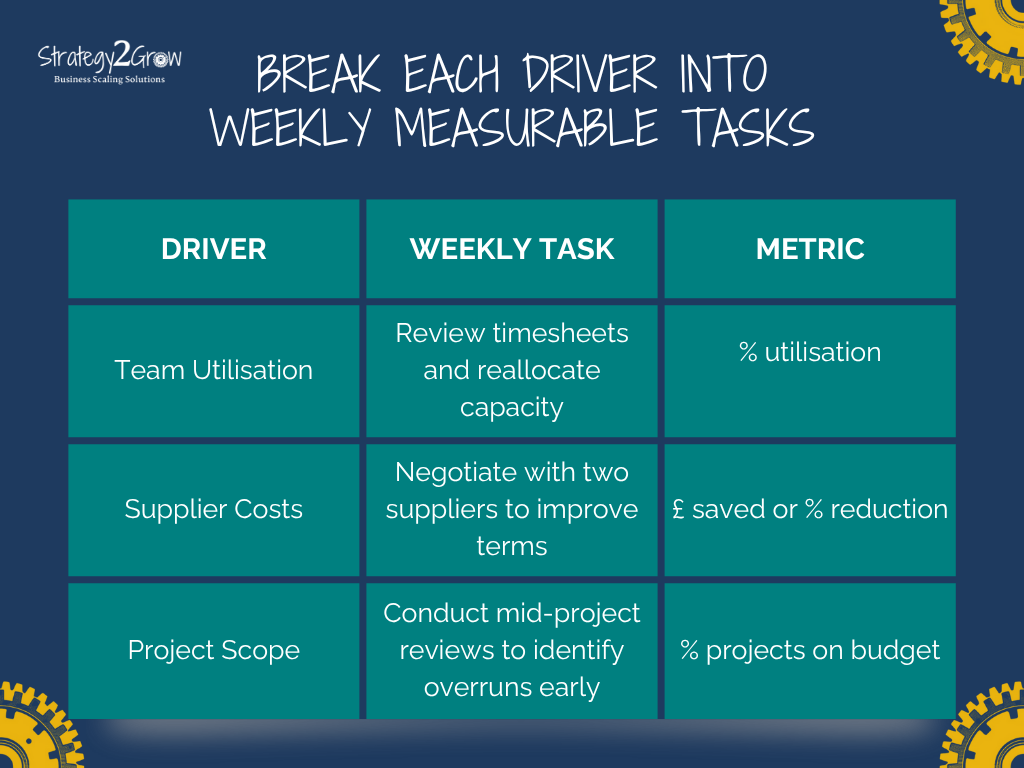
Simple. Focused. Accountable.
When your plan is this clear, there’s no confusion about what moves the business forward.
Step 4: Review Weekly
Once a week, hold a 30-minute review meeting.
Keep the structure consistent:
Are we on track to hit our 13-week goal?
What do the metrics tell us?
What are the priorities for next week?
Avoid emotional conversations and stay data-driven. The goal is not to justify results but to understand them.
This rhythm of weekly reflection keeps everyone aligned and prevents small issues from becoming major setbacks.
Step 5: Reflect and Recalibrate in Week 13
At the end of each sprint, stop and reflect.
What worked well?
What didn’t?
What needs to change for the next cycle?
This isn’t a post-mortem; it’s a learning process. Document your insights, celebrate wins, and carry those lessons into your next sprint.
Over time, this reflection becomes your most valuable leadership tool. It helps you build a smarter, stronger business with every iteration.
What Happens When You Plan in 13-Week Cycles
Companies that implement sprint planning consistently report the same outcomes:
Clarity: Everyone knows exactly what matters.
Calm: The business stops reacting to every new opportunity and starts executing the plan.
Consistency: Progress becomes predictable.
A sprint plan removes the clutter. It brings focus back to the essentials: your people, your priorities, and your profit.
Instead of trying to predict an entire year, you build momentum every 90 days.

Lesson Giants From The Giants
Even global companies run on rhythm, not reaction.
Procter & Gamble (P&G), one of the world’s largest consumer goods companies, is known for using the OGSM framework: Objectives, Goals, Strategies, and Measures. This model breaks long-term strategy into short, focused execution cycles.
Each quarter, leadership teams review performance data, align priorities, and refine initiatives based on results. The approach creates accountability, agility, and clear ownership across departments. It’s how P&G maintains consistency and innovation across hundreds of global brands while continuing to adapt to shifting market conditions.
Atlassian, the company behind tools such as Jira and Trello, operates in a similar rhythm. Their entire planning system revolves around quarterly goals. Each team defines three to five specific, measurable outcomes every quarter, reviews what worked, and adjusts priorities for the next cycle. This process creates clarity, transparency, and focus, helping teams stay aligned with company-wide objectives while maintaining the flexibility to innovate quickly.
You don’t need to be a global powerhouse to apply the same principle. Whether you’re leading a £2 million business or a £20 million one, structure scales what chaos cannot.
The Real Purpose of Planning
Planning isn’t about predicting the future; it’s about preparing to lead it.
The 13-week sprint framework helps you do exactly that. It gives you and your team the discipline to focus on what matters most, the agility to adapt quickly, and the rhythm to sustain growth over time.
When founders learn to lead in rhythm, their businesses move differently. They stop sprinting from one crisis to the next and start leading from clarity, calm, and confidence.
It’s not about doing more; it’s about doing what truly moves the business forward.
Ready to Build Your 13-Week Sprint Plan?
If you’re serious about scaling in 2026, stop guessing what’s holding you back. In six minutes you can find out exactly why growth feels harder than it should.
Take the free Growth Readiness Scorecard and get a clear picture of what’s working, what’s not, and where to focus next. No fluff, no theory, just the truth about what’s keeping your business from scaling smoothly.
Get your personalised report and start fixing the friction today.
Take the free Growth Readiness Scorecard now
Final Thought
Scaling isn’t about speed; it’s about rhythm.
When you plan in 13-week cycles, you replace stress with strategy and motion with progress. You start leading with intention, not reaction.
Because sustainable growth doesn’t come from doing more. It comes from doing what matters most, consistently, with purpose.
That’s the real secret of the 13-week sprint.
